
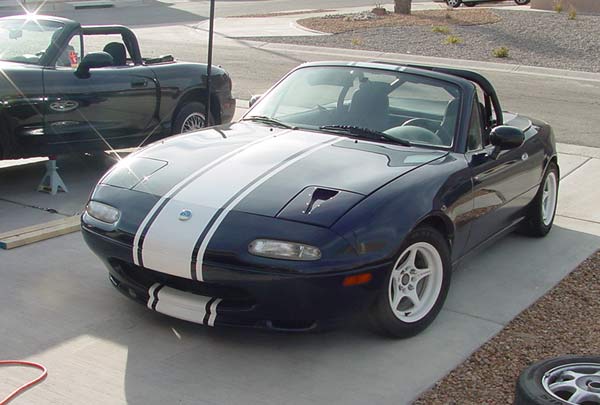
A completed NACA duct air inlet, installed on my Miata
Looking for instructions on making your own duct?
Check out my NACA duct install page. I took plenty of
pictures and tried to detail each step of the process of creating your own NACA duct headlight lid. On this page
(the one you're looking at right now), you won't find specific slot-a to tab-b instructions, but you
will learn a little about NACA ducts in general.

About NACA ducts
A NACA duct is a common form of low-drag intake design, originally developed by the National Advisory Committee for Aeronautics in 1945. When properly implemented, it allows fluid (usually air) to be drawn into an internal duct, with a minimal disturbance to the flow or increase in drag. The design was originally called a "submerged inlet," since it consists of a shallow ramp with curved walls recessed into the exposed surface of a streamlined body, such as an airplane or race car. (thanks Wikipedia!)
A few words on implementing your own NACA duct as a means of induction to your race car. 1: design is very important. The duct is designed to be efficient with the correct wall angles (sharp), base slope, and width-to-depth ratio. 2: The duct needs to be installed in an area of high pressure. A leading edge of a car is a great place. The Miata headlight is almost too far back. Placing a NACA-style duct on a car hood would result in a poorly flowing inlet, in my opinion. 3: most headlight inlet ducts on the market (at least for Miatas) are not of the correct design, so don't look at them as examples. At the time of this writing, you could download the original NACA spec from their archive. Just in case it moves and I don't notice, I've included a few key pieces from the report.
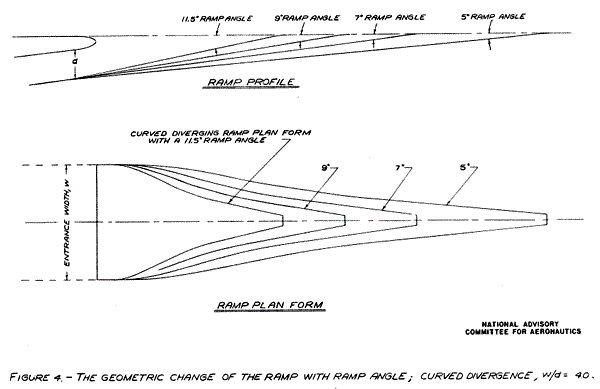
A width-to-depth ratio of about 3-5 and a ramp angle of about 7 degrees is optimal.
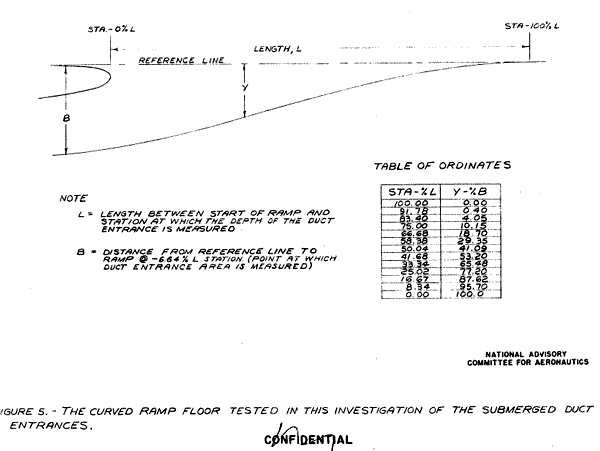
Take note of the airfoil at the back of the duct. It enhances the duct's performance.
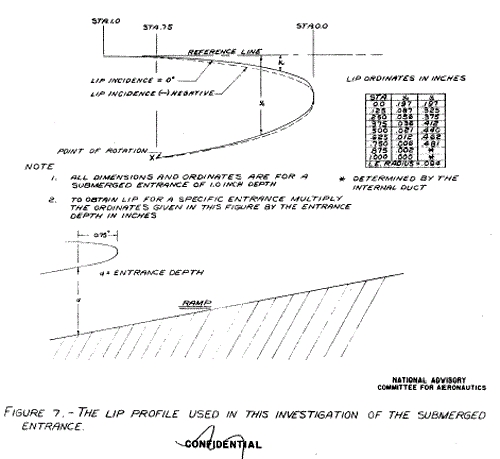
Airfoil lip profile: a nice, rounded profile provides best suction.
Where to get one
Life is already hard enough. Building a NACA duct won't be the easiest thing you've ever tried to do with your dremel and some sheet metal, so why not make it a little less painful? There are places on the web from which you can buy a pre-fabricated NACA duct. All you've got to do is somehow install it on your car. The one you see here came from McKinney Corp, a business that usually caters to drag racers. They sell 3 sizes of NACA duct that will easily fit into most popup headlights (at least, they fit Miata headlights). The one I have is the largest, their 4" duct, which fits between my dual Moss low-pro headlights perfectly. There are other sources which can be found with a quick Google search, but I was so happy with McKinney, that they're the only one I'll link to on this page. The duct was very inexpensive at about $30 shipped.
NACA duct photos

The installed duct. Note the 90 degree edges.
This is an example of a correctly designed NACA inlet, in my opinion. It's installed in a high pressure zone and maintains each and every attribute that contributes to a high efficiency, low drag inlet. The only room for improvement is a curved floor, but, since the duct comes from a 3rd party, that's not really a possibility. The duct is installed with Bondo to make a sharp wall, then reinforced with stainless button head cap screws.
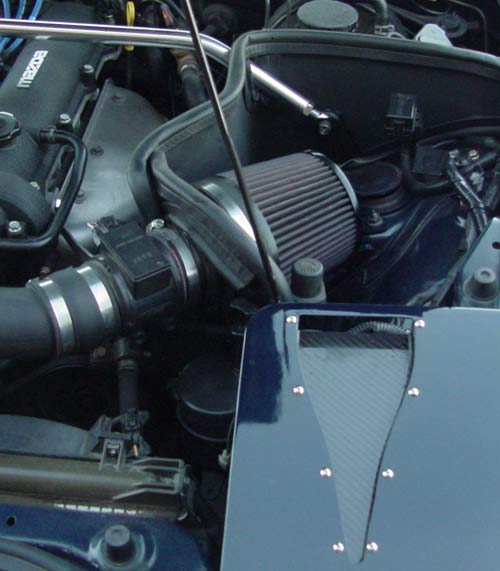
What the duct is feeding.
Here is the duct delivering cold air to my filter (a few airbox incarnations ago). The airbox assures that the cold air isn't simply zooming past the filter. The box also doesn't seal completely. There's a small void in the back section to keep the airflow from stalling.
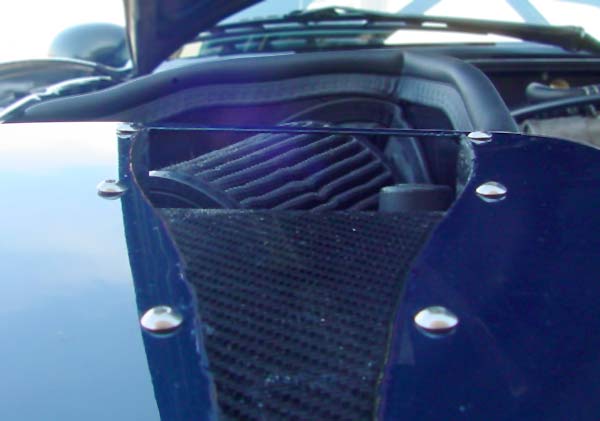
My 2nd attempt at a headlight lid intake.
This pic shows my coldside intake. You can see the filter directly being blown upon by the duct. This picture shows an absence of an airfoil at the back of the duct.
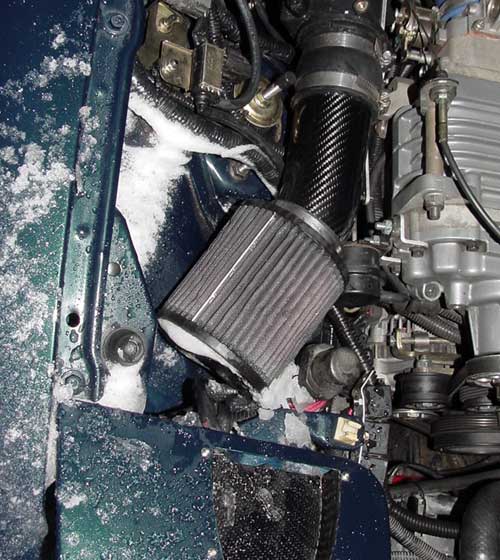
A new definition for "Cold air intake."
Some folks seem to think that air will not flow into a NACA headlight lid intake, but rather flows outward. This photo is my attempt to answer that question visually. In reality, I was caught in a blizzard in my Miata, but afterward I found this nice little snow drift and thought to take a picture of it. Air indeed flows in the duct, even at 10 mph (the speed I got to creep home at that day).

Original 97 engine with intake being fed by the NACA duct.
Site Navigation
Latest Blog Posts
CarbonMiata Vent Window Install/Review
Posted on Mon, 30 Jan 2023 01:47:44 +0000
 After waiting 23 years, there's finally a pretty vent window kit on the market for the NA/NB Miata. Unfortunately, it doesn't actually work well.
Read more...
Period-Correct 90s Rear Speakers
Posted on Mon, 11 Oct 2021 02:12:26 +0000
 Sharka's rear package tray now holds more than just a rollbar. A set of 90s speakers is the next upgrade for the little blue and white boi.
Read more...
GV Tail Light Upgrade
Posted on Tue, 28 Sep 2021 02:05:06 +0000
 TLDR; LEDs are brighter, who knew?
Read more...
Mona Visits Joshua Tree
Posted on Sat, 26 Jun 2021 03:21:12 +0000
 Mona checks out the curious multi-armed residents of Joshua Tree National Park
Read more...
KINOD 15
Posted on Sun, 20 Jun 2021 22:49:33 +0000
 Mona and I made the pilgrimage to SoCal for the 15th Anniversary KINOD Event.
Read more...

Products sold on this site are for Off-road and Competition use only. This website intended solely to provide general guidance on matters of interest for the personal use of the Reader of this Page, who accepts full responsibility for its use. All products as well as information provided "as is," with no guarantee of completeness, accuracy, or timeliness, and without warranty of any kind, express or implied, including, but not limited to, the warranties of performance, merchantability, and fitness for a particular purpose.